
A refined picking technique is one of the defining elements of clean, professional guitar playing. While the fretting hand shapes the notes, the picking hand determines timing, articulation, attack, and consistency. To develop true control, it’s essential to understand the relationship between tempo, note values, and the physical demands placed on your picking motion.
Picking and Time: A Technical Perspective
The duration of each picked note is governed by tempo (BPM) and rhythmic subdivision. The faster the tempo or the smaller the note value, the less time you have to execute each stroke.
Where:
- t = duration of one note (seconds)
- BPM = beats per minute
- n = notes per beat (1 = quarter notes, 2 = eighth notes, 4 = sixteenth notes)
Note Duration Table
The following table illustrates how much time is available per note at different tempos and subdivisions:
| Note Value | 60 BPM | 120 BPM | 180 BPM |
|---|---|---|---|
| Quarter Notes | 1.000 s | 0.500 s | 0.333 s |
| Eighth Notes | 0.500 s | 0.250 s | 0.167 s |
| Sixteenth Notes | 0.250 s | 0.125 s | 0.083 s |
At higher tempos, the available time per note becomes extremely limited. This directly impacts how efficient and controlled your picking motion must be.
The following tablature uses a single C note to demonstrate how note lengths and tempo affect picking timing.
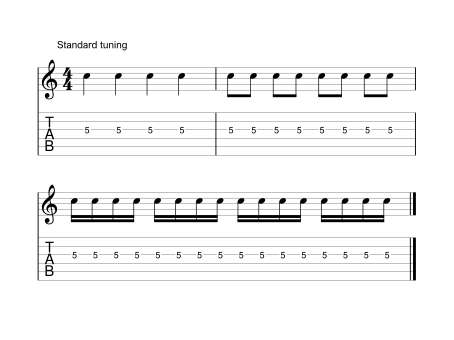
Let’s hear how the different note lengths sound at 60 BPM. Notice the clear spacing between quarter notes, eighth notes, and sixteenth notes.
Now listen to the same note lengths at 120 BPM. The reduced time between notes already requires more precise and controlled picking.
Finally, here is the example at 180 BPM. Especially with sixteenth notes, the available time per pick stroke becomes extremely short, demanding efficient motion and accurate timing.
As tempo increases, precision, synchronization, and economy of motion become increasingly important for maintaining clean and accurate picking technique.
Technique Tips for Efficient Picking
Minimize Motion
Efficient picking relies on reducing unnecessary movement to the absolute minimum. Large, exaggerated strokes increase travel time and make it difficult to maintain consistency at higher speeds. Focus on compact, economical motions where the pick barely clears the string before reversing direction.
Stay Relaxed
Muscle tension is one of the primary limitations to speed and accuracy. When the hand and forearm are tense, movement becomes restricted and timing suffers. Maintain a loose grip on the pick and allow the motion to feel natural and fluid, especially during faster passages.
Use Consistent Pick Angles
A slight angle between the pick and the string reduces resistance and allows smoother string traversal. This minimizes friction and helps maintain consistent attack across all strings. Experiment with subtle angle adjustments to find the most efficient contact point for your playing style.
Alternate Picking
Alternate picking (down-up motion) ensures rhythmic consistency and mechanical efficiency. Relying on a single direction (e.g., all downstrokes) quickly becomes limiting at higher tempos. Developing strict alternate picking builds endurance, precision, and evenness across phrases.
Synchronization: The Critical Factor
Precise picking must be matched by equally accurate fretting-hand timing. Both hands need to operate in perfect synchronization, especially as note durations become shorter. Even minor timing discrepancies become clearly audible at higher speeds.
A structured practice approach:
- Start at a slow tempo (e.g. 60 BPM with sixteenth notes)
- Prioritize clean, even note attacks
- Gradually increase tempo while maintaining control
Conclusion
Picking technique is fundamentally a matter of executing precise movements within strict time constraints. As tempos increase, the window for each note shrinks dramatically, demanding efficiency, relaxation, and synchronization. By understanding the timing behind each note and refining your motion accordingly, you build a foundation for speed, clarity, and professional-level control.