
I recently pulled the full electric guitar catalog from a well-known online music retailer — 1,803 listings across 34 manufacturers, with everything from body wood to fret size logged per instrument. Rather than let that sit in a spreadsheet, I ran the numbers on questions that come up constantly in gear forums: which brands actually dominate the market, what pickup layout is the de facto standard, how much does a guitar actually cost, and where is the stuff really built? Here’s what the data says.
Guitar Count by Manufacturer
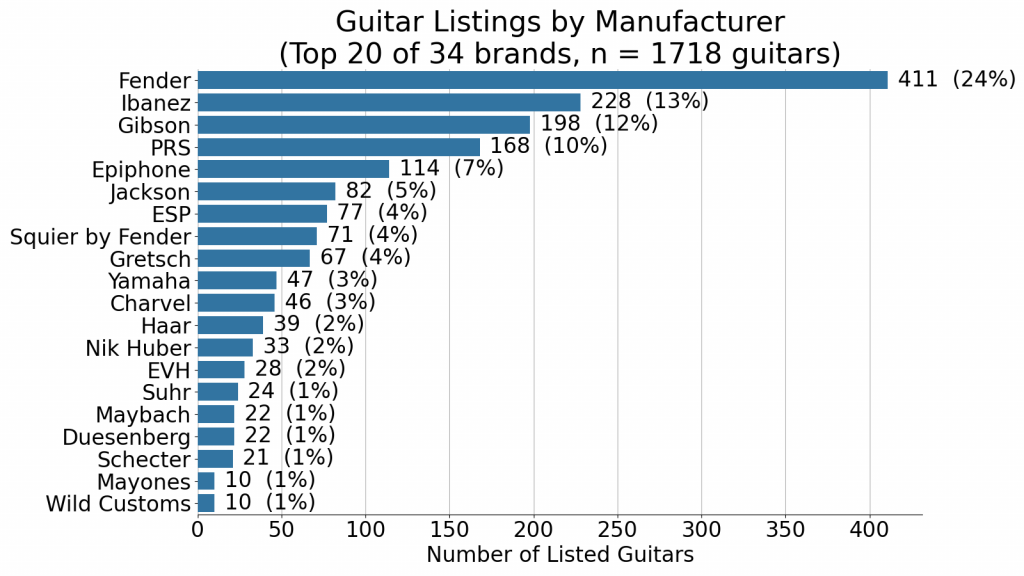
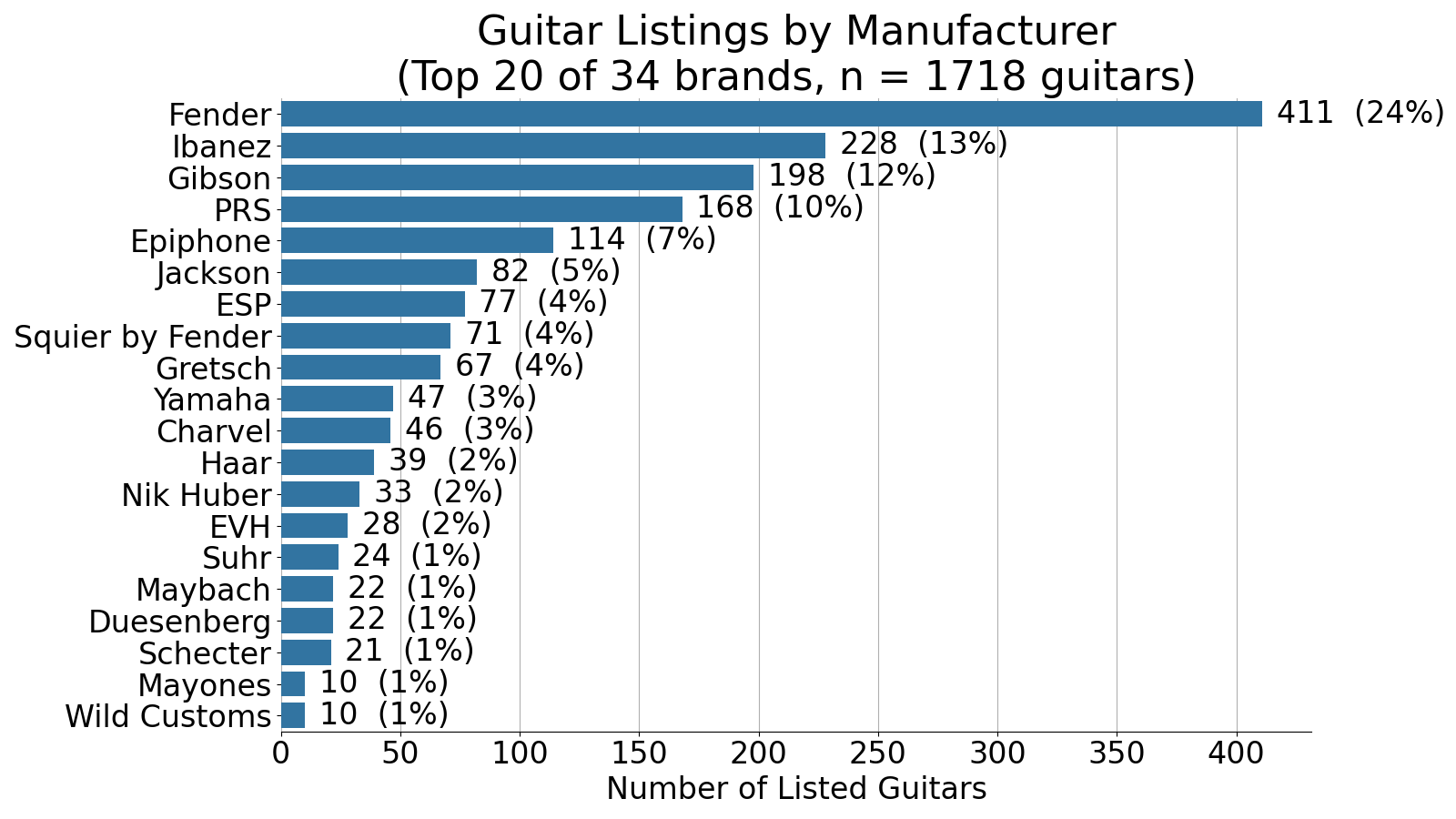
No surprise at the top: Fender leads with 411 listings, roughly 23% of the entire catalog, followed by Ibanez (232) and Gibson (199). What’s more interesting is the shape of the long tail. PRS (168) and Epiphone (114) round out a clear “big five,” and after that the field fragments fast — Jackson, ESP, and Squier by Fender each land in the 70–85 range, and from Gretsch downward every brand accounts for less than 4% of listings individually.
Two things worth flagging if you’re reading this as a market snapshot rather than a popularity contest: Epiphone and Squier are counted separately from Gibson and Fender, so if you merge parent/sub-brand pairs, the “Fender family” and “Gibson family” numbers grow substantially. And catalog depth isn’t market share — a retailer’s SKU count reflects buying and distribution decisions as much as what guitarists actually own. Boutique builders like Nik Huber (33) or Haar (39) will always look tiny next to Fender in a listings count, even though they occupy a completely different price and craft tier.
Pickup Systems
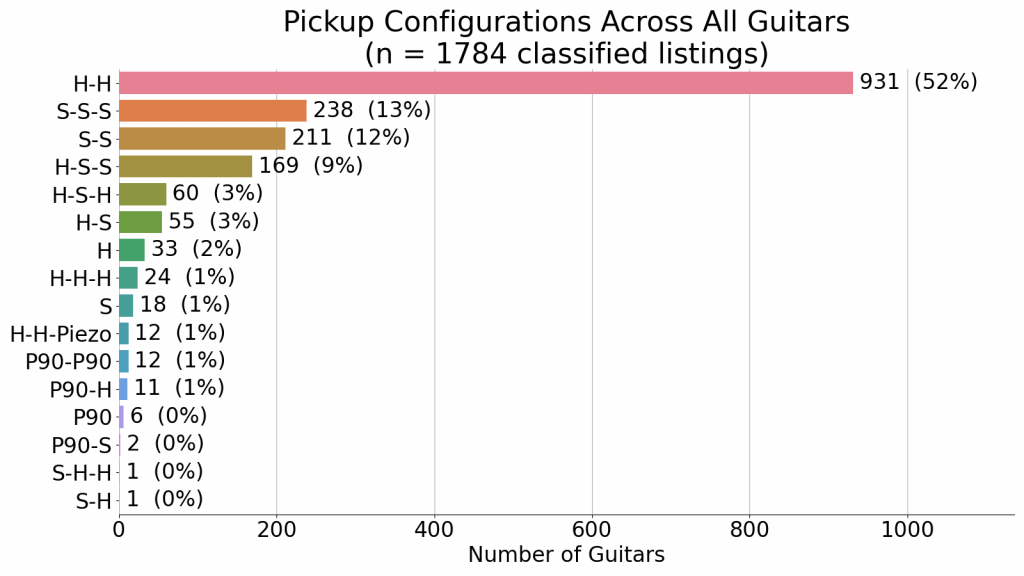
If you had to bet on a single pickup layout to represent “the electric guitar” in 2026, the data says bet on HH — two humbuckers. It accounts for 931 of the 1,784 classified listings, 52% of the entire catalog, dwarfing every other configuration combined.
Behind that, the picture is basically a map of guitar sub-genres: Mixed HSS/HSH (229, 12%) is the Strat-adjacent “one humbucker for lead, single coils for everything else” compromise; SSS, triple single coil (238, 13%) is the classic Stratocaster layout; SS, dual single coil (211, 12%) is Telecaster and Jazzmaster-style wiring. Single humbucker (33), P90 (31), triple humbucker (24), and single single-coil (18) make up the remaining long tail.
Price Distribution
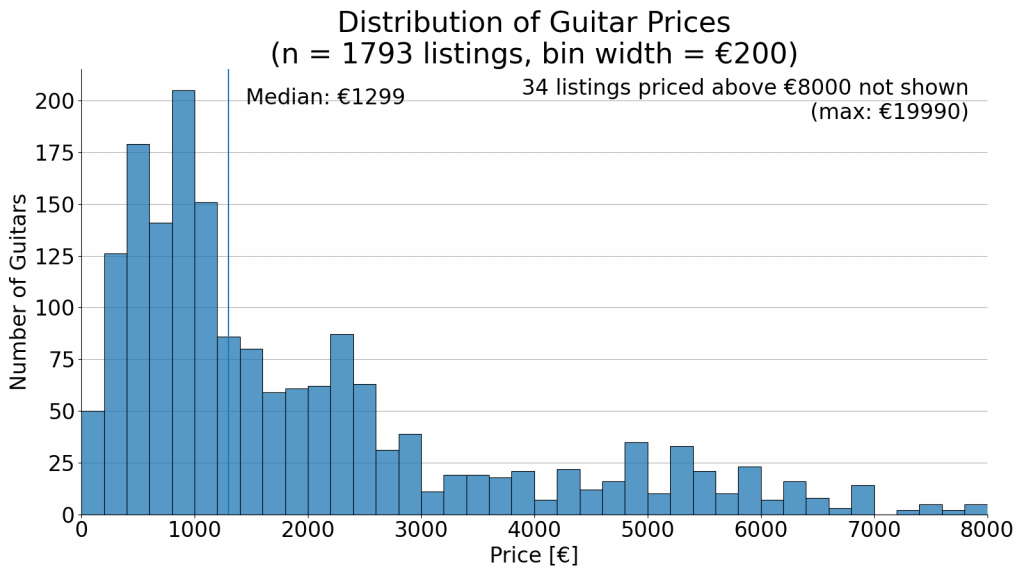
The catalog’s median price is €1,299, but the distribution is heavily right-skewed — a long tail of high-end and boutique instruments pulls the mean up to €2,111. Most of the volume sits comfortably under €3,000: this is a market dominated by mid-range production guitars, with expensive custom-shop and boutique-builder instruments (some priced well above €8,000, up to a €19,990 outlier) forming a thin but visible tail rather than the bulk of listings. If you’re building a “typical guitar” mental model from this catalog, the €700–€1,600 band is where most of the actual inventory lives.
Average Price by Country of Origin
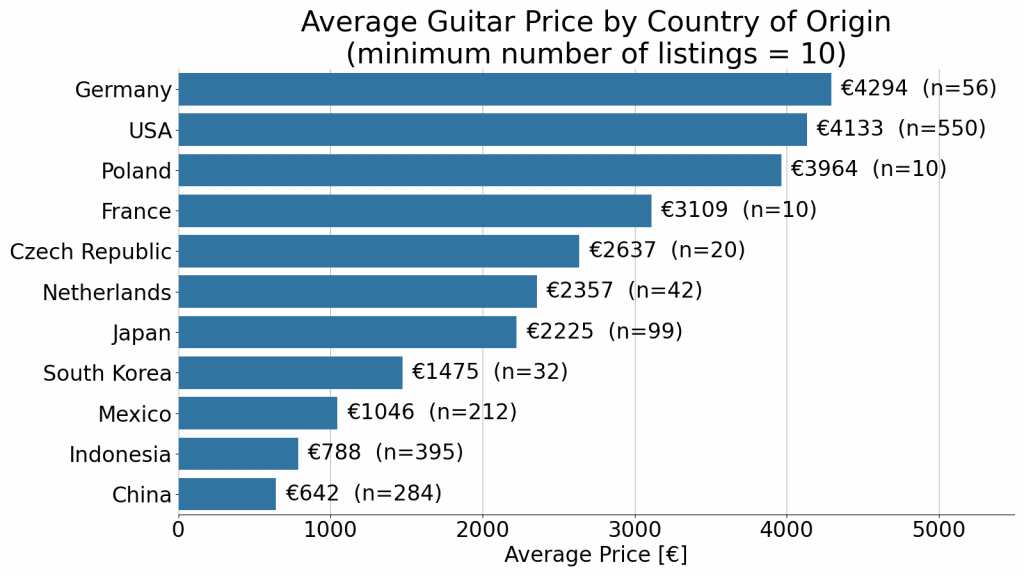
Country of origin turns out to be one of the strongest price signals in the whole dataset — essentially a price tier label in disguise. Germany (€4,294) and the USA (€4,128) sit at the top, followed by a mid-tier cluster of Poland, France, and the Czech Republic (roughly €2,600–€4,000, though on smaller sample sizes) and Japan (€2,225) and the Netherlands (€2,357). At the budget end, South Korea (€1,475), Mexico (€1,045), Indonesia (€787), and China (€641) anchor the mass-market segment. The roughly 6.4x gap between the cheapest and most expensive origin countries is a bigger price driver, on average, than brand name alone — which is exactly why brands like PRS and Fender run the same model name across multiple manufacturing countries at very different price points.
Country of Origin
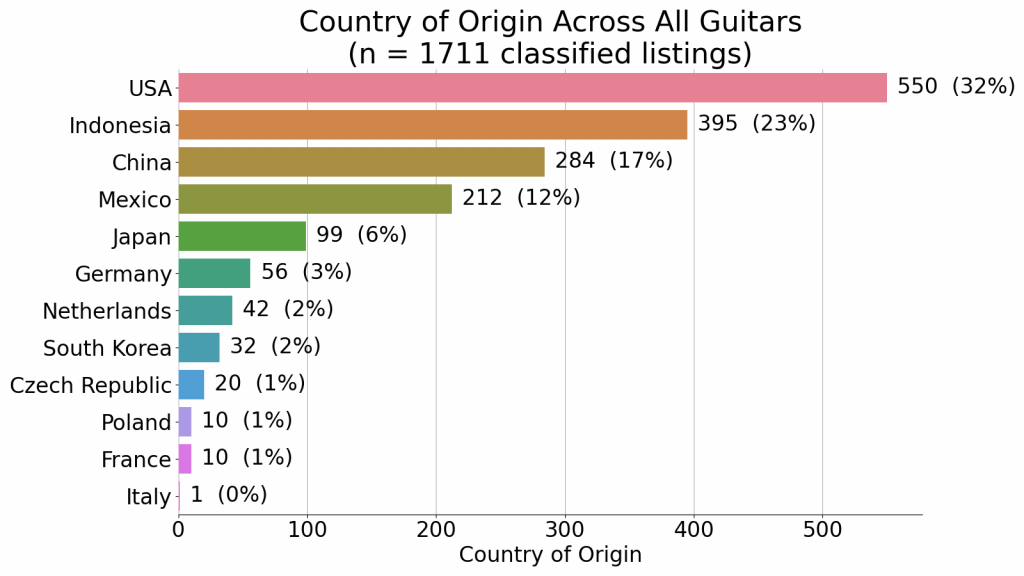
Zooming out from price to volume: the USA (550, 32%) and Indonesia (395, 23%) together account for over half of every guitar in the catalog, with China (284, 17%) close behind. Mexico (212, 12%) and Japan (99, 6%) round out the mid tier, while Germany, the Netherlands, South Korea, the Czech Republic, and a handful of smaller producers (France, Poland) split the remaining single-digit percentages. Read alongside the price chart above, the story is clear: roughly half the market by volume is built in higher-cost countries (USA), and the other half is anchored by high-volume, lower-cost manufacturing hubs (Indonesia, China) — there’s very little middle ground, which mirrors the “big brand vs. budget tier” split we saw in the manufacturer counts.
Takeaways
Pull these five charts together and a fairly coherent story emerges: a small handful of legacy brands (Fender, Gibson, Ibanez, PRS) account for the majority of the market; the typical guitar sold today is a €1,000–€1,600 instrument with two humbuckers and passive electronics; and country of origin — split heavily between the USA and a cluster of Asian manufacturing hubs — is one of the single strongest price predictors in the whole dataset, functioning less as a geography fact and more as an unofficial price tier baked into nearly every brand’s lineup.
Data source: full electric guitar catalog crawl from an online music retailer, 1,803 listings, July 2026.