
The minor pentatonic scale is one of the most essential tools in modern guitar playing. Found in blues, rock, metal, pop, and even jazz, it is often the first scale guitarists learn – yet it remains a lifelong resource for phrasing, improvisation, and songwriting. Its strength lies in its simplicity: fewer notes, strong musical character, and excellent compatibility with common chord progressions.
In this article, we’ll take a clear, practical look at the A minor pentatonic scale, focusing on its five positions across the fretboard, how they connect, and how you can start using them musically rather than mechanically.
What Is the Minor Pentatonic Scale?
The minor pentatonic scale is a five-note scale derived from the natural minor scale.
Formula (intervals):
1 – ♭3 – 4 – 5 – ♭7
A Minor Pentatonic notes:
- A (root)
- C (minor third)
- D (perfect fourth)
- E (perfect fifth)
- G (minor seventh)
Because the scale omits the 2nd and 6th degrees of the natural minor scale, it avoids strong harmonic tension. This makes it extremely forgiving and ideal for improvisation.
The Five Positions of A Minor Pentatonic
The pentatonic scale covers the entire fretboard through five interconnected shapes, often referred to as positions or boxes. Each position contains the same five notes, just arranged differently.
We’ll start at the most common one and work our way up the neck.
Position 1
This is the most widely recognized pentatonic pattern and typically the first one learned by guitarists.
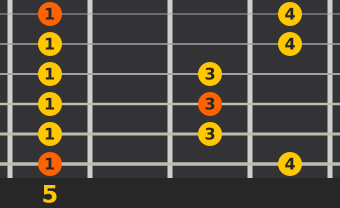
Each position includes an example of the scale played in ascending and descending order. Use these exercises to become familiar with the note layout and to build consistency in your playing.
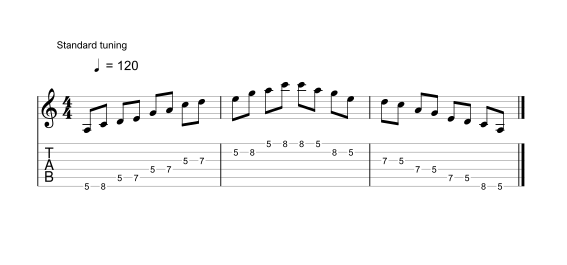
Let’s hear how this sounds:
Key characteristics:
- Roots located on the 6th and 1st strings
- Strong blues and rock phrasing area
- Ideal for bends and vibrato
This position sits comfortably over an Am chord and is heavily used in blues and classic rock solos.
Position 2
Position 2 extends upward from Position 1 and introduces new phrasing possibilities.
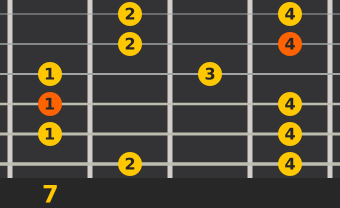
Example of the scale played in ascending and descending order:
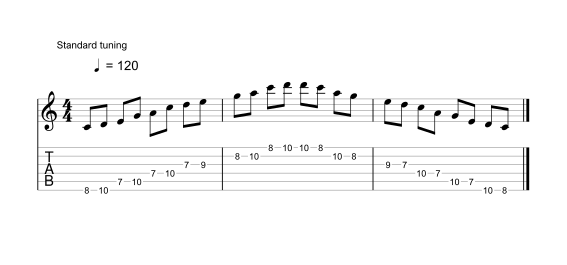
Let’s hear how this sounds:
Key characteristics:
- Smooth transition area between lower and middle neck
- Useful for melodic runs
- Encourages horizontal movement
This position is a natural next step when you want to break out of the “box” feeling.
Position 3
Position 3 has a slightly more angular sound and is often underused – making it a great place to develop a unique voice.
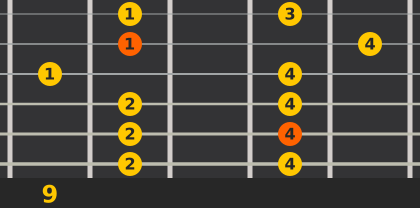
Example of the scale played in ascending and descending order:
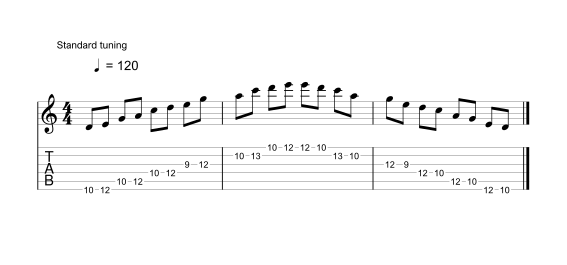
Let’s hear how this sounds:
Key characteristics:
- Balanced between rhythm and lead playing
- Excellent for sequences and legato phrases
- Frequently used in modern rock and fusion styles
It acts as a bridge connecting lower blues phrasing with higher melodic soloing.
Position 4
Because the 12th fret marks the octave, this position feels familiar and symmetrical.
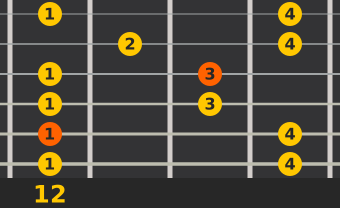
Example of the scale played in ascending and descending order:
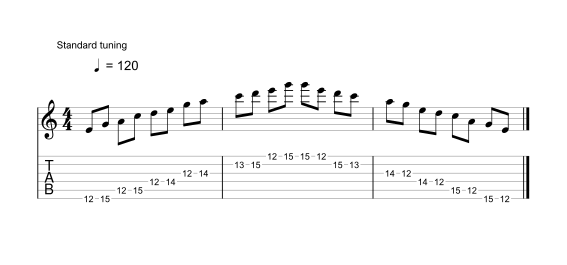
Let’s hear how this sounds:
Key characteristics:
- Bright tonal character
- Great for expressive bends on higher strings
- Strong melodic clarity
This position often feels “emotional” because of its register and bending opportunities. Many lead guitarists favor this area for singing, vocal-like solos.
Position 5
This position completes the cycle and connects back to Position 1. You can also move this position one octave up starting on the 15th fret.
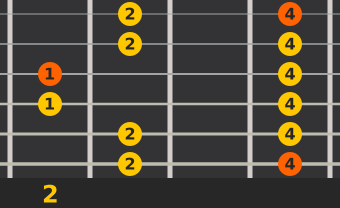
Example of the scale played in ascending and descending order:
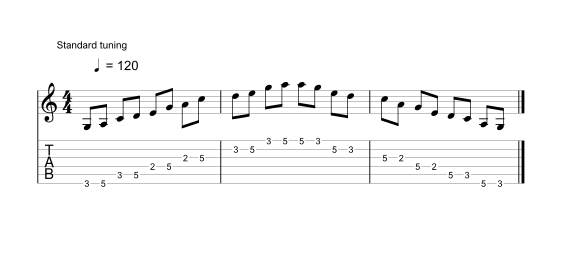
Let’s hear how this sounds:
Key characteristics:
- High-register soloing
- Fast runs and expressive vibrato
- Seamless looping across the fretboard
From here, you naturally resolve back into Position 1.
Connecting the Positions Visualizing the Full Fretboard
The five positions are not separate scales – they are interconnected views of the same notes. Advanced players stop thinking in boxes and instead visualize:
- Root notes across all strings
- Overlapping patterns
- Chord tones inside each position
A useful exercise is to play Position 1 and gradually shift into Position 2 without stopping, then continue through all five shapes.
Transposing the Positions
An important advantage of the minor pentatonic scale on guitar is its movable nature. All five positions described above are based on relative shapes, not fixed notes. This means they can be shifted anywhere on the fretboard to play in a different key.
For example:
- Move Position 1 from the 5th fret (A) to the 3rd fret → G minor pentatonic
- Move it to the 7th fret → B minor pentatonic
The same applies to all other positions. As long as you correctly place the root note, the entire pattern will produce the corresponding minor pentatonic scale in that key. This makes the system extremely efficient and practical for real-world playing situations.
Final Thoughts
The minor pentatonic scale is simple in structure but endlessly deep in musical potential. Mastering all five positions in A minor unlocks the entire fretboard and provides a foundation for blues phrasing, rock solos, and advanced improvisation concepts.
Rather than memorizing shapes mechanically, aim to understand how the positions connect. Once the fretboard becomes a continuous musical landscape, the minor pentatonic scale transforms from a beginner exercise into a powerful creative language.