
If you’ve ever watched a seasoned guitarist tear through a blazing solo with machine-like precision, chances are you’ve witnessed the power of alternate picking. This technique is one of the fundamental building blocks of clean, articulate, and efficient guitar playing. Whether you’re a blues enthusiast looking to tighten up your phrasing, a metal guitarist chasing speed, or a jazz player striving for clarity in your lines, alternate picking is a skill that elevates your playing across every genre.
In this article, we’ll explore what alternate picking is, why it matters, and how you can master it with intention, accuracy, and musicality.
Description
Alternate picking is exactly what it sounds like: using alternating downstrokes and upstrokes to pick each consecutive note. Instead of relying solely on downstrokes (which is common for many beginners) or upstrokes alone, alternate picking creates a balanced and efficient motion that promotes speed and consistency.
At its core:
- Downstroke → Upstroke → Downstroke → Upstroke,
- or Upstroke → Downstroke → Upstroke → Downstroke, depending on your starting point.
This simple mechanical pattern revolutionized modern guitar technique. Legendary players such as Paul Gilbert, John Petrucci, Al Di Meola, and Yngwie Malmsteen have refined it to an art form – each one using alternate picking to achieve blistering speed and incredibly clean articulation.
Technique Details
Mastering alternate picking isn’t just about moving the pick up and down. There’s a science (and a bit of magic) to making it feel effortless. Below are the key elements to focus on.
1. Hand Position & Grip
Your picking hand should feel relaxed and natural. Most players hold the pick between the thumb and index finger, angling it slightly for a smoother glide across the strings. A tense grip is the enemy – keep things firm but flexible.
2. Motion Source
Great alternate pickers use small, controlled movements. The motion typically comes from:
- The wrist (most common and efficient)
- A slight rotation of the forearm
- Minimal finger assistance for micro-adjustments
Avoid large “windshield wiper” arm motions – they waste energy and slow you down.
3. Consistent Pick Depth
Digging too far into the string creates resistance. A shallow, controlled pick depth ensures speed and accuracy.
4. Timing & Rhythmic Precision
Alternate picking is only effective when locked into the beat. Practicing with a metronome is essential – not optional. Start slow, focus on even spacing, and gradually build speed.
5. String Crossing
One of the most challenging aspects is moving cleanly between strings. Practice both:
- Inside picking (downstroke on a higher string followed by an upstroke on a lower string)
- Outside picking (upstroke on a higher string followed by a downstroke on a lower string)
Both patterns train your hand to move fluidly across the fretboard.
Examples
Here are a few practical exercises you can incorporate into your practice routine. Start slow and increase the tempo only when your playing is clean and relaxed.
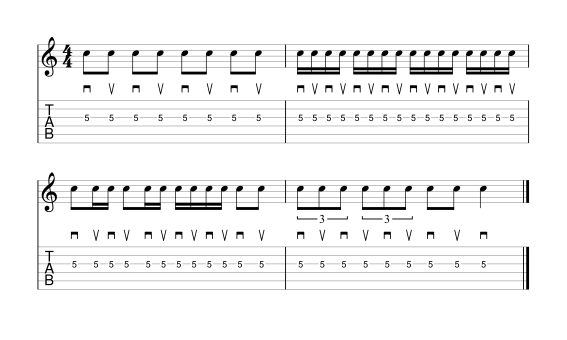
Example 1: Single-String Exercise
This exercise focuses on pure alternate motion without the challenge of string crossing using different ryhthmical patterns. Other rhythmic patterns can also be used. These patterns can be varied by playing it on a different string, on a different fret, or with a different finger.
Let’s hear how that sounds:
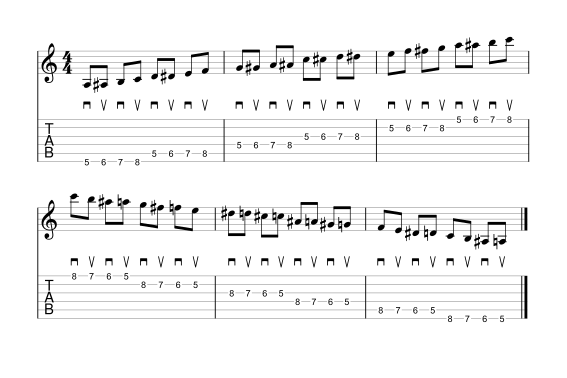
Example 2: Multiple-String Crossing Exercise
This pattern forces you to maintain alternate strokes while moving between strings. This is a basic exercise which can also be adapted to other finger sequences like 1-3-2-4, 2-1-3-4, or 4-2-3-1. This is also a good warm-up exercise before playing or practicing.
Let’s hear how that sounds:
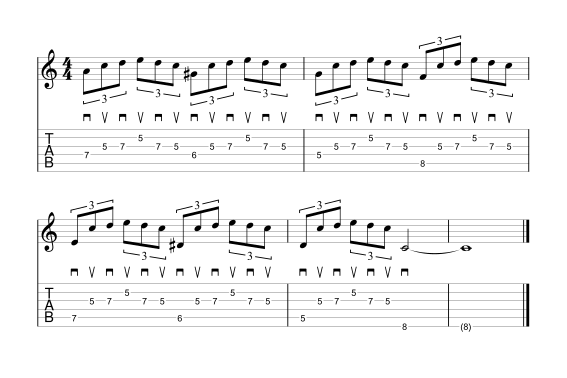
Example 3: String-Skipping Exercise
This is another exercise with many string changes, and it even involves switching between strings that are not next to each other.
Let’s hear how that sounds:
Conclusion
Alternate picking may seem simple at first glance, but it’s one of the deepest, most transformative techniques a guitarist can develop. It enhances your accuracy, strengthens your timing, expands your speed limits, and ultimately gives you the tonal clarity that separates intermediate players from professionals.
Consistency is the key – daily, focused practice will yield impressive results over time. Stay relaxed, stay patient, and most importantly… stay musical.
Summary
- Alternate picking uses alternating downstrokes and upstrokes for efficiency and control.
- Success comes from relaxed motion, consistent pick depth, and wrist-focused mechanics.
- Use a metronome, start slow, and build speed only when your playing is clean.
- Mastering string-crossing patterns is crucial.
- Incorporate musical examples to develop real-world fluency.
Alternate picking is a lifelong companion on your guitar journey – one that will make you a cleaner, faster, and more expressive musician. Keep practicing, and you’ll unlock a level of control that transforms your playing from the ground up.